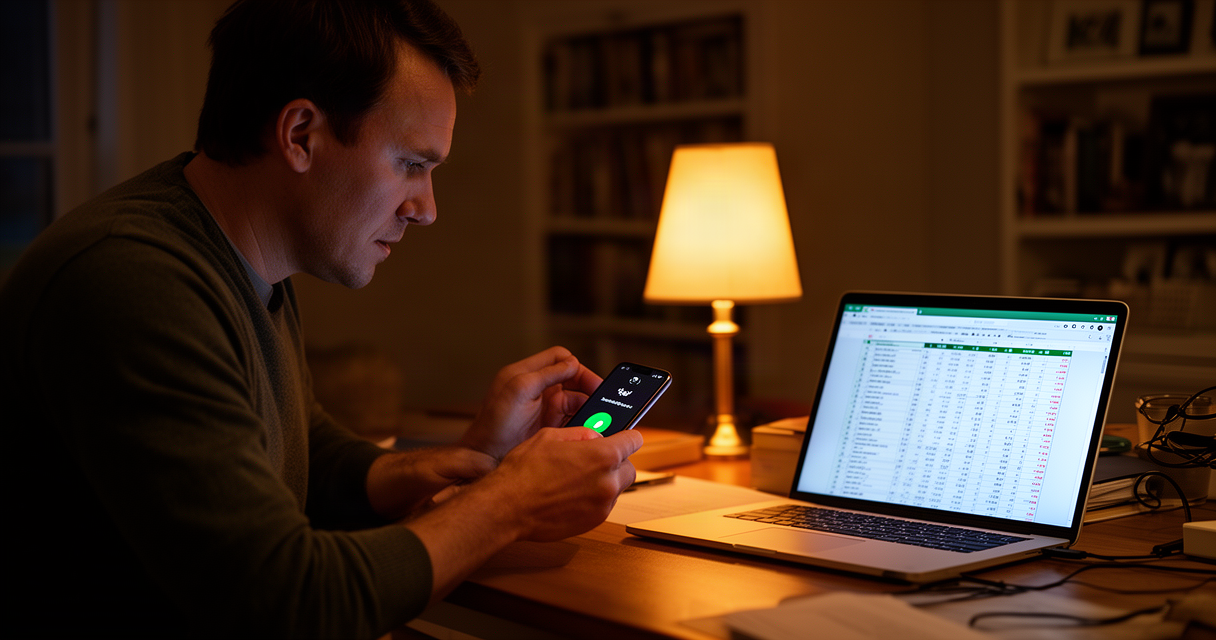
A tenant call comes in during a lease showing. It goes to voicemail. By the time there’s a callback, it’s an angry text about a leak that’s been running for six hours — or worse, nobody picks up at all during something that actually needed an immediate answer.
For a self-managing landlord running 1 to 20 units, that gap is expensive in two different ways. Missed routine calls cost renewals and let small maintenance issues turn into big ones. Missed emergency calls create real legal exposure if a tenant genuinely cannot reach anyone when something goes wrong.
The quick answer: for routine call volume — rent questions, maintenance intake, scheduling, after-hours message-taking — an AI answering service is worth it for most small self-managers, and it costs a fraction of a live answering service or a full-time assistant. It is not a substitute for an actual emergency response plan. The escalation path for a gas leak or a flooded unit needs to be tested with fake scenarios before it’s trusted with real ones, and tenant materials should keep a plain “call 911 for life-threatening emergencies” instruction regardless of which tool is running the phone line.
None of this is legal advice. Habitability and emergency-response obligations vary by state and municipality, and no software changes what a landlord is legally required to do. What follows is the practical breakdown.
What an AI Answering Service Actually Does (and What It Isn’t)
The core job is narrow: answer inbound tenant calls 24/7, capture why someone is calling, handle FAQ-type questions (office hours, rent due date, how to submit a work order), confirm or schedule appointments, and route or take a message when it can’t resolve the call itself.
That’s it. It’s tenant call support for an existing lease relationship — not a prospect-facing tool. A leasing chatbot that qualifies applicants and books showings for prospective renters is a different product solving a different problem for a different buyer; AppFolio’s AI leasing assistant sits in that separate category. An AI answering service handles phone intake only. Maintenance dispatch, full property management, and emergency response are separate jobs it does not do.
Tenants notice the difference between a tool that resolves their problem and one that just relays it. One caller on r/AIReceptionists summed up the frustration plainly: “If I go to the trouble of calling a number, I want a person. I don’t want prompts that are usually wrong and have to repeat myself.”
“AI answering service” is a marketing umbrella covering products with meaningfully different capabilities underneath it. Knowing exactly which job is being bought — intake and routing, not resolution — is the first filter before comparing vendors.
The Real Question: Can It Handle an Actual Emergency?
This is the section that actually matters, and it’s where most vendor pages get vague on purpose.
Most AI answering tools are built to detect urgency keywords — gas, smoke, flooding, no heat, fire, carbon monoxide, lockout — and immediately escalate: transfer to a live human, dispatch a preset emergency vendor, or instruct the caller to call 911. They are not designed to resolve the emergency themselves, and none of them should be trusted to freelance a judgment call on a live safety issue.
One operator on r/PropertyManagement laid out the right mental model: “I’d outsource the answering, not the judgment… I would not let any AI/answering layer freestyle on gas, electrical, water, access, or habitability issues. It should collect facts, route to the predefined emergency path, and clearly say when a human needs to make the call.” Another added the sharper version of the same warning: “The gas meter triage situation is exactly the scenario where message-taking services fall apart, you need someone who can actually reason through ‘is this an emergency, who do I call, and what do the tenant do right now.’”
The gap between routine and judgment-heavy calls shows up consistently in how tenants react. A comment on r/AIReceptionists framed it well: “Depends completely on your call types imo. ‘What are your hours’ and ‘I want to book’ it handles fine. Anything requiring real judgment, it’ll frustrate people.”
The proptech marketing outruns the reality specifically on judgment calls. The real risk is assuming “AI answering service” automatically means “emergency covered” when the escalation path has never been tested against a fake gas-leak or burst-pipe call.
To repeat: this is not legal advice. Emergency-response duties differ by state and city, and no AI tool guarantees it will catch every emergency correctly. The honest framing is risk-reduction and triage support layered on top of a landlord’s own emergency plan — not a replacement for one.
GoodCall vs Dialzara vs Smith.ai for a Small Portfolio
Three products come up most often in this space, and they represent three different bets.
GoodCall is a reported AI phone agent built for small businesses, including landlords — 24/7 answering, scheduling, and some property management integrations. Pricing is reported in the roughly $39 to $249-plus per month range depending on tier and call volume, though sources disagree and plans change, so current pricing should be confirmed on GoodCall’s own site.
Dialzara is a reported AI virtual receptionist that markets specifically to property managers for after-hours tenant Q&A and message-taking. Reported pricing runs from about $29/month on the low-minute tier up to roughly $349/month, plus per-minute overage — again, confirm current numbers on dialzara.com before committing.
Smith.ai is different in kind, not just in price. It’s a human-plus-AI hybrid, not a pure AI product — the AI Receptionist tier is reported around $95/month plus per-call charges, with a live-human tier running several hundred dollars a month. It’s pricier and less pure-AI, but it buys better judgment on ambiguous calls.
For a 1-20 unit self-manager, GoodCall and Dialzara are the budget pure-AI options that fit the call volume a small portfolio actually generates. Smith.ai makes sense for someone who specifically wants a human safety net on judgment calls and can absorb the higher cost, especially near the top of that unit range. General-purpose AI receptionist platforms and DIY builds (Vapi, for example) also exist as a broader category for landlords comfortable configuring their own call flows.
Marketing pages matter less than whether a vendor’s emergency-escalation flow can actually be tested and trusted against a real vendor list before real tenants start calling it.
AI Answering Service vs. a Part-Time VA vs. Missing Calls
Three options exist for handling the tenant phone line, and they trade off differently.
An AI answering service is the cheapest and wins clearly on routine volume — rent questions, scheduling, after-hours message-taking. It’s weakest on judgment and on tenants who simply want to talk to a person.
A part-time VA costs more per month, with general market rates commonly cited around $15 to $25-plus per hour (a general range, not independently verified for property management work specifically), but a human VA brings actual judgment and doesn’t frustrate a tenant who wants to be heard rather than processed.
Missing calls — still the default setup for a lot of small landlords — costs $0/month and is often the most expensive option long-term. Lost renewals, small maintenance issues that balloon, and eroded tenant trust add up quietly.
Some landlords are already blending these. One post on r/Landlord described a setup where the automation does most of the work: “Built a voice AI that answers tenant calls and routes them to the right contractor or to me depending on what they need… Honestly most of the process runs without me at this point except for showings which I haven’t figured out yet.” A skeptical reply pushed back on the assumption that tenants would go along with it: “The voice AI for routing calls is smart, haven’t seen many landlords go that far. How are tenants responding to it? I feel like half of mine would just hang up and text me anyway.”
Both points are right. AI wins on cost for routine volume. A VA or hybrid setup wins on judgment and tenant comfort. They aren’t mutually exclusive — the setups that actually work combine AI or a live service for routine and after-hours overflow with a tested handoff to a human for anything that requires judgment.
What It Costs at Small-Portfolio Scale
At the call volume a 1-20 unit landlord actually generates, most AI answering plans land in an entry tier — roughly $30 to $100 per month across GoodCall, Dialzara, and similar products, before any overage charges kick in.
One property manager on r/PropertyManagement, running a portfolio closer to 500 units, reported paying under $50/month for a pay-per-call after-hours service — a useful data point because it illustrates why per-call and per-minute pricing stays cheap for small operations specifically: fewer calls means the bill stays near the floor of the pricing tier regardless of portfolio size.
Compare that to a full-time receptionist, commonly cited in vendor marketing at roughly $2,500 to $4,000 per month (directional, not independently verified), or a part-time VA at that same $15-25-plus per hour range. At small scale, the entry price for trying an AI answering service is low enough that testing it carries almost no financial risk, regardless of raw capability. As always, current pricing should be confirmed on each vendor’s official page before signing up.
Who It’s Worth It For / Who Should Skip It
Worth it: self-managers with 3 or more units who regularly miss calls, want after-hours coverage without hiring a live human, and are willing to spend 30 to 60 minutes setting up and testing the emergency-escalation flow before going live.
Skip it, or wait: landlords with 1-2 units and genuinely low call volume, where the ROI doesn’t clear the time cost of setup and monitoring. Also skip it — or at minimum, don’t trust it yet — if there’s no willingness to build and test a real emergency decision tree first. An untested AI on a gas-leak or fire call is worse than no AI at all, because it creates a false sense that the problem is handled.
Consider a VA instead for a tenant base that consistently wants a human voice, or a portfolio generating frequent ambiguous, judgment-heavy calls that don’t fit a script.
Consider Smith.ai’s hybrid model for landlords near the top of the small-portfolio range — 15 to 20 units — who want a human safety net without the overhead of hiring a VA outright.
It’s worth noting how rare true emergencies actually are at small scale. One landlord on r/PropertyManagement questioned the whole premise: “Honestly how often are you having after-hours emergency calls? I self manage 35 units and I cant think of the last time I had an after hour emergency” — drawing the half-joking reply, “Get a 24/7 ai answering service my man.” The counterpoint is fair: for very low call volume, the ROI case weakens regardless of which tool gets picked.
How to Set It Up Safely
Step 1: Write the emergency decision tree first. Gas smell routes to the utility company and 911. Active flooding routes to the water shutoff and an emergency plumber. No heat in freezing weather routes to emergency HVAC. Fire or smoke always routes to 911. The AI executes this triage — it doesn’t invent its own.
Step 2: Test the escalation path with 5 to 10 realistic fake scenarios before any real tenant calls hit the line. This is the single highest-leverage step and the one most landlords skip.
Step 3: Keep a plain written instruction — “call 911 for life-threatening emergencies” — in the lease and move-in materials. It doesn’t fully solve the problem (panicked tenants will still text a landlord directly), but it’s a documented, good-faith step.
Step 4: Know what happens after the call. The AI captures and routes a maintenance request, but tracking, prioritizing, and dispatching the actual repair is a separate job — pairing the answering service with dedicated maintenance request software closes that gap.
Step 5: Re-test the emergency flow periodically, especially after any change to the vendor list.
Landlords on r/PropertyManagement describe roughly this same framework in practice: “‘For fire, smoke, flooding, or gas leaks, call 911 first, then contact me,’ plus using an answering service or emergency vendor backup can make a huge difference.” Another distilled the triage logic even more bluntly: “Fire, Flood or blood is a true emergency call — if someone calls because of any other reason they would have to wait until the morning.”
An AI answering service works best as an add-on layered on top of a core management stack, not a replacement for one — several small landlords run it alongside free landlord management platforms like TurboTenant, Avail, or Innago.
Our Take
AI answering services solve a genuinely painful problem — missed calls and zero after-hours bandwidth — and they’re good at routine volume for a price that’s hard to argue with. The hype outruns reality specifically on judgment calls in true emergencies, and that gap is a liability issue worth real setup time, not an afterthought.
GoodCall and Dialzara are the sensible pure-AI picks for most 1-20 unit self-managers on cost alone. Smith.ai earns its premium only for landlords who specifically want human judgment in the loop and are willing to pay for it. None of these products “solves” emergency response — that responsibility stays with the landlord. The tool only handles intake; deciding what happens next stays with the landlord.
It also belongs in the same conversation as the rest of a landlord’s piecemeal AI stack, alongside tools like AI tenant screening software — useful pieces, none of them a complete system on their own.
The Verdict
For routine call volume, an AI answering service is a cheap and genuinely useful upgrade over missed calls and voicemail for most small self-managers. It is an intake layer, not an emergency plan — treating it as the latter without testing the escalation path first is the actual risk here, not the monthly bill.
Before picking a vendor, write the emergency decision tree first, then run 5 to 10 fake scenarios through a trial of GoodCall, Dialzara, or Smith.ai — all three offer trials — and decide based on price and fit for the unit count.
The tool answers the phone, but the landlord still has to decide in advance what happens after it does.
FAQ
Can an AI answering service handle a real emergency?
Not on its own. Most tools detect urgency keywords and escalate — transfer to a human, dispatch a preset vendor, or tell the caller to call 911 — rather than resolving the emergency. Test the escalation path with fake scenarios before trusting it, and never rely on it as the only emergency response system. This isn’t legal advice, and no tool guarantees it catches every emergency.
How much does an AI answering service cost for a small landlord?
At small-portfolio call volume, most plans land around $30 to $100 per month before overage, based on reported GoodCall and Dialzara tiers. Smith.ai’s hybrid model runs higher, roughly $95/month plus per-call charges for the AI tier. Pricing changes and sources disagree, so confirm current numbers on each vendor’s official page.
What’s the difference between GoodCall, Dialzara, and Smith.ai?
GoodCall and Dialzara are pure-AI answering products aimed at small businesses and landlords, priced for low call volume. Smith.ai is a human-plus-AI hybrid — better judgment on ambiguous calls, but a higher price floor. The choice comes down to budget versus how much human judgment is needed on the line.
Is an AI answering service better than a virtual assistant for landlords?
Neither wins outright. AI wins on cost for routine, high-volume tasks like scheduling and FAQ handling. A VA wins on judgment and tenant comfort for ambiguous or emotionally charged calls. Many landlords run both — AI for routine and after-hours overflow, a human handoff for anything judgment-heavy.
Will tenants know they’re talking to an AI, and will they mind?
Some will notice immediately, and reactions on r/AIReceptionists and r/Landlord suggest a meaningful share of tenants want a human the moment a call requires actual judgment. Simple, scripted interactions (hours, scheduling) tend to go unnoticed or unremarked; anything more complex tends to frustrate callers who feel stuck in a script.
Does using an AI answering service make me legally compliant with emergency response duties?
No. This is not legal advice, and no AI answering service makes a landlord legally compliant with habitability or emergency-response obligations, which vary by state and municipality. These tools function as risk-reduction and triage support — the underlying legal duty to respond to emergencies stays with the landlord regardless of what software is running the phone line.